Vastus Lateralis: 7 Power Moves for Strong Thighs
Introduction
Vastus lateralis, the largest and most powerful member of the quadriceps muscle group, forms the sweeping outer curve of your thigh that’s essential for everything from sprinting to squatting. Often overshadowed by its flashier “teardrop” counterpart on the inner thigh, this lateral thigh muscle plays a starring role in knee stability and explosive leg power. In this comprehensive guide, we’ll dive deep into vastus lateralis location, origin, and insertion, explore its leg muscle function as a key knee extension muscle, and arm you with practical quadriceps exercises to build strength. We’ll also tackle common pitfalls like vastus lateralis pain and strain, compare it head-to-head with vastus medialis, and outline quadriceps rehabilitation strategies for recovery. Whether you’re a gym enthusiast chasing that outer quad sweep or someone sidelined by thigh muscle injury, this article delivers actionable insights to get your legs firing on all cylinders. Let’s power up those thighs!
Understanding Vastus Lateralis: Thigh Muscle Anatomy Basics
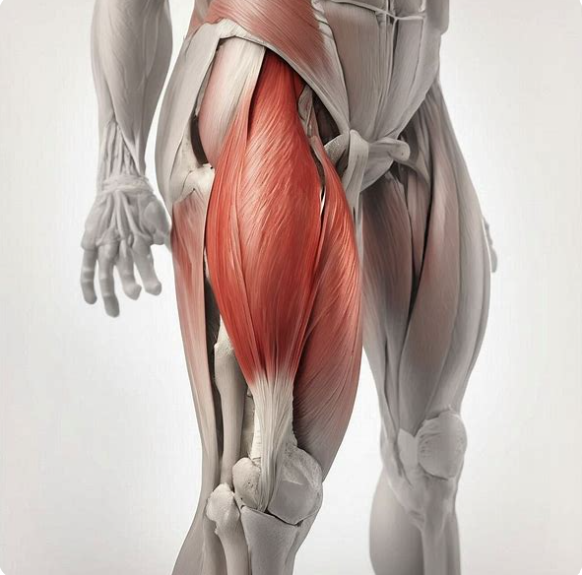
When it comes to thigh muscle anatomy, the vastus lateralis stands out as the biggest of the four quadriceps muscles. This flat, broad muscle dominates the lateral side of your thigh, giving it that defined, outer contour many athletes strive for in bodybuilding circles. But beyond aesthetics, understanding its structure is crucial for preventing injuries and optimizing workouts.
Vastus Lateralis Location and Structure
The vastus lateralis location is precisely on the outer aspect of the thigh, running parallel to the femur bone. It’s one of the four heads of the quadriceps muscle: alongside the rectus femoris (the central one crossing both hip and knee), vastus medialis (inner thigh), and vastus intermedius (deep underneath). Together, they form the powerhouse front of your leg, but the vastus lateralis steals the show for size and visibility.
Visually, picture it as a thick sheet of muscle wrapping from the upper thigh down toward the knee, blending seamlessly with the iliotibial (IT) band for added lateral support. This positioning makes it integral to the overall thigh muscle anatomy, counterbalancing inner forces to keep your knee tracking straight during movement.
Vastus Lateralis Origin and Insertion Points
Delving deeper into vastus lateralis origin and insertion reveals why it’s so robust. It originates from several key spots on the femur: the intertrochanteric line (near the hip), the greater trochanter’s base, the linea aspera (a rough ridge along the thigh bone), and the lateral supracondylar ridge just above the knee. These multiple attachment points allow for massive force generation.
From there, the muscle fibers converge into a strong tendon that inserts at the tibial tuberosity via the quadriceps tendon, right below the kneecap. This setup enables seamless integration with the patella, ensuring smooth knee extension. Fun fact: its flat aponeurosis—a sheath of connective tissue—runs along the outer thigh, providing a gliding surface that reduces friction during high-rep leg days.
Innervation comes from the femoral nerve (roots L2-L4), which sends signals for contraction, while blood supply via the lateral circumflex femoral artery keeps it oxygenated during intense efforts. Weaknesses here, like nerve compression, can lead to thigh muscle injury, so monitoring form in heavy lifts is key.
In essence, the vastus lateralis isn’t just bulk—it’s a biomechanical marvel designed for endurance and power in the quadriceps muscle group.
The Crucial Role of Vastus Lateralis in Leg Muscle Function
As a premier knee extension muscle, the vastus lateralis drives some of your most fundamental movements. Its primary job? Straightening the knee against resistance, whether you’re kicking a soccer ball or climbing stairs. But its contributions go beyond basics, influencing everything from gait to athletic performance.
Knee Extension and Stability
In leg muscle function, the vastus lateralis teams up with its quad siblings to extend the knee joint fully. During the stance phase of walking or running, it fires to lock the knee, absorbing impact and propelling you forward. This knee extension muscle action is vital for activities like jumping, where it generates up to 80% of the force needed for takeoff.
It also stabilizes the patella in the femoral groove, preventing lateral drift that could cause pain. Imbalance here—say, a dominant vastus lateralis pulling against a weaker vastus medialis—can lead to patellofemoral stress syndrome, a common runner’s woe.
Everyday and Athletic Applications
Think about daily life: rising from a chair relies on vastus lateralis contraction to initiate knee extension without wobbling. In sports, it’s the engine behind cyclists’ pedal strokes or weightlifters’ squat drives. Studies show that strengthening this muscle improves sprint speed by enhancing power output in the final knee-lock phase.
Moreover, its role in maintaining thigh position during dynamic moves like lunges underscores why neglecting it invites vastus lateralis strain. Prioritizing balanced quadriceps development ensures fluid, injury-free motion.
Vastus Lateralis Workout: Top Quadriceps Exercises for Strength
Ready to sculpt that outer thigh? A dedicated vastus lateralis workout targets this lateral thigh muscle through compound and isolation moves. Focus on narrow stances and controlled eccentrics to maximize engagement. Below, we’ll break down seven powerhouse quadriceps exercises, complete with step-by-step guidance. Aim for 3-4 sets of 8-12 reps, twice weekly, to build strength without overtaxing recovery.
Essential Strengthening Quadriceps Moves
Here’s a quick-reference table of our top picks, highlighting focus areas:
| Exercise | Primary Target | Equipment Needed | Reps/Sets |
|---|---|---|---|
| Close-Stance Leg Press | Outer quads, glutes | Leg press machine | 10-12 / 3 |
| Dumbbell Lunges | Knee extension, balance | Dumbbells | 8-10 per leg / 3 |
| Barbell Front Squat | Full quads, core | Barbell | 8-10 / 4 |
| Bulgarian Split Squat | Unilateral vastus lateralis | Dumbbells, bench | 10 per leg / 3 |
| Hack Squat Machine | Lateral thigh muscle | Hack squat machine | 12 / 3 |
| Sissy Squat | Advanced isolation | Sissy squat bench | 6-8 / 3 |
| Straight-Leg Raises | Rehab-friendly activation | None | 15 / 3 |
1. Close-Stance Leg Press
This gem zeros in on the vastus lateralis by narrowing your foot placement. Sit in the machine, feet shoulder-width or closer on the platform (toes slightly out). Lower until knees hit 90 degrees, then explode up, squeezing your quads at the top. The close stance shifts load to the outer thigh, firing leg muscle function for real-world power.
2. Dumbbell Lunges
Step forward into a lunge, dumbbells at sides, lowering until your rear knee nearly touches the ground. Push through the front heel to return, emphasizing the knee extension muscle pull. This dynamic move challenges balance while torching the quadriceps muscle—perfect for athletes.
3. Barbell Front Squat
Load a barbell across your front shoulders, elbows high. Squat down until thighs are parallel, then drive up. The upright torso demands vastus lateralis dominance, enhancing thigh muscle anatomy awareness and overall leg strength.
4. Dumbbell Bulgarian Split Squat
Elevate your rear foot on a bench, front foot forward. Descend into a single-leg squat, keeping the front knee tracking over toes. This unilateral exercise isolates the working leg’s vastus lateralis, building symmetry and preventing imbalances.
5. Hack Squat Machine
With shoulders under pads and feet mid-platform (narrow), slide down to 90 degrees, then press back. The fixed path amplifies outer quad recruitment, making it a safe staple for vastus lateralis workout newbies.
6. Sissy Squat
Kneel with feet anchored, lean back slowly while keeping hips extended, then return. This bodyweight burner isolates the knee extension muscle like few others—start assisted if needed.
7. Straight-Leg Raises
Lie supine, one knee bent for stability. Lift the straight leg to 45 degrees, hold, and lower slowly. Ideal for beginners or rehab, it activates the quadriceps without joint stress.
Incorporate these into your routine progressively. Warm up with dynamic stretches, and pair with foam rolling for the lateral thigh muscle to enhance recovery. Over time, you’ll notice that coveted quad sweep emerging.
Tackling Vastus Lateralis Pain: Causes and Prevention
No one wants to deal with vastus lateralis pain derailing their gains. This discomfort often stems from overuse, poor form, or imbalances in the quadriceps muscle group, manifesting as sharp twinges during squats or a dull ache post-run.
Common Sources of Discomfort
Vastus lateralis strain typically arises from sudden thigh muscle injury, like a forceful kick or eccentric overload in jumps. Symptoms include swelling, bruising, and limping—hallmarks of a grade 1-3 tear. Tight IT bands can exacerbate it, rubbing against the muscle and causing friction syndrome. Runners and cyclists are prime suspects, as repetitive knee extension without recovery invites inflammation.
Patellofemoral pain syndrome (PFPS) often implicates the vastus lateralis too, where lateral pull misaligns the kneecap, leading to grinding sensations. Early signs? Tenderness along the outer thigh or weakness in leg presses.
Prevention Strategies
- Warm-Up Wisely: Spend 5-10 minutes on light cardio and dynamic leg swings to prime blood flow.
- Balance Training: Alternate unilateral exercises to even out quadriceps development.
- Recovery Rituals: Ice post-workout (10-15 minutes) and stretch daily to maintain flexibility.
If pain persists beyond a week, consult a pro—ignoring it risks chronic thigh muscle injury.
Vastus Medialis vs Vastus Lateralis: Key Differences and Balance
Ever wondered why your inner knee feels “teardrop-y” while the outer thigh bulges? That’s vastus medialis vs vastus lateralis in action—two quad heavyweights with distinct vibes.
Anatomical and Functional Contrasts
The vastus lateralis, as the outer powerhouse, sweeps the thigh laterally and excels in pure knee extension force. Its vastus lateralis origin spans the femur’s outer ridges, inserting broadly for stability. In contrast, the vastus medialis hugs the inner thigh, with its oblique (VMO) portion angling downward to pull the patella medially, countering lateral drift.
Functionally, both drive knee extension, but the vastus medialis shines in patellar tracking during the last 30 degrees of extension—crucial for locking the knee without wobble. Overdeveloped vastus lateralis without VM strength? Hello, knee valgus and PFPS risk.
Tailored Exercises for Balance
- For Vastus Lateralis: Narrow-stance squats emphasize the outer sweep.
- For Vastus Medialis: Wide-stance leg presses or terminal knee extensions fire the inner quad.
Aim for harmony: Alternate focus weekly to fortify the entire quadriceps muscle.
Quadriceps Rehabilitation: Healing Vastus Lateralis Strain
Thigh muscle injury doesn’t have to sideline you forever. Quadriceps rehabilitation for vastus lateralis strain follows a phased approach, blending rest, mobility, and progressive loading for a swift return.
Phase 1: Acute Management (Days 1-3)
- RICE Protocol: Rest, ice (10-15 mins every 2 hours), compression, elevation. Add gentle massage to ease swelling.
- Pain Threshold: Allow up to 4/10 discomfort in early moves.
Phase 2: Mobility and Isometrics (Days 4-14)
Start with prone quad stretches: Loop a towel around your ankle, pull gently while prone, holding 30 seconds x3. Progress to isometrics—hold a stride stance wall sit for 60 seconds x3.
Phase 3: Strengthening (Weeks 2-6)
Incorporate split squat progressions: Begin isometric, advance to dynamic with 3-second eccentrics. Reverse Nordics build eccentric control: Kneel and lean back slowly, 4-8 reps x3-4.
Phase 4: Return to Function (Week 6+)
Test with pain-free sprints and kicks. Criteria? Equal 10-rep max on leg extensions to the uninjured side. Plyometrics like box jumps seal the deal.
Patience pays: Most recover in 6-8 weeks, but consistency in quadriceps rehabilitation trumps speed.
Frequently Asked Questions (FAQs)
What is the vastus lateralis and why does it matter for leg muscle function? The vastus lateralis is the outer quadriceps muscle shaping your thigh’s sweep. It powers knee extension in walks, runs, and lifts—vital for stability and preventing vastus lateralis pain from imbalances.
How can I target the vastus lateralis in my quadriceps exercises routine? Opt for narrow-stance leg presses or Bulgarian split squats in your vastus lateralis workout. These emphasize the lateral thigh muscle, building that outer quad pop while strengthening quadriceps overall.
What’s the difference between vastus medialis vs vastus lateralis in thigh muscle anatomy? Vastus lateralis bulks the outer thigh for power, while vastus medialis stabilizes the inner knee with its teardrop shape. Balancing both via targeted exercises avoids knee extension muscle strains.
How do I treat vastus lateralis strain at home? Start with RICE for thigh muscle injury, then ease into gentle stretches like the standing quad pull. If pain lingers, professional quadriceps rehabilitation ensures full recovery without setbacks.
Are there specific stretches for vastus lateralis pain relief? Yes! Try the kneeling quad stretch: Pull your heel to glutes while lunging forward, holding 30 seconds. This loosens the knee extension muscle, easing discomfort from overuse.
Can strengthening quadriceps help prevent vastus lateralis injury? Absolutely—regular vastus lateralis workouts like front squats build resilience. Focus on eccentrics to mimic real-life loads, cutting thigh muscle injury risk by up to 50%.
What’s a beginner-friendly vastus lateralis workout? Kick off with bodyweight straight-leg raises and wall sits. Progress to dumbbell lunges for full quadriceps engagement, keeping reps controlled to master leg muscle function basics.
Conclusion
From its strategic vastus lateralis location in thigh muscle anatomy to its starring role as a knee extension muscle, the vastus lateralis is your ticket to unbreakable legs. We’ve covered everything from powerhouse quadriceps exercises and strengthening quadriceps tips to navigating vastus lateralis pain, strain comparisons like vastus medialis vs vastus lateralis, and robust quadriceps rehabilitation paths. Armed with this knowledge, you’re set to sculpt, strengthen, and safeguard your thighs.
Don’t wait—pick three exercises from our list, hit the gym today, and feel the difference in your stride. Your stronger, pain-free legs await. What’s your first move? Share in the comments below!
(Word count: 2,512)